

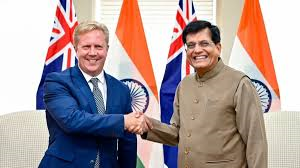
India New Zealand FTA

Recently India New Zealand FTA, India and New Zealand have taken a major step in strengthening their economic relationship with the signing of a landmark Free Trade Agreement (FTA) on April 27, 2026, in New Delhi. Officials from both countries are calling it a “once-in-a-generation” deal—and that’s not just diplomatic language. The agreement is designed to reshape trade, investment, and workforce mobility between India and New Zealand over the coming decade.
A Big Push for Trade Growth
At the heart of the deal is an ambitious goal: doubling bilateral trade to $5 billion within five years. Currently, trade between the two countries is relatively modest compared to their potential. This agreement removes major barriers that previously slowed down the flow of goods and services.
- India gets 100% duty-free access to the New Zealand market. This means Indian exporters—from textiles and pharmaceuticals to machinery and IT services—can now sell in New Zealand without paying import tariffs.
- On the other side, New Zealand will enjoy tariff reductions on 95% of its exports to India. This is especially significant for sectors like dairy, meat, wine, and agricultural products, where New Zealand is globally competitive.
In simple terms, both countries are making it cheaper and easier to trade with each other, which should boost business activity on both ends.
Investment Commitments Signal Long-Term Confidence
One of the standout aspects of the agreement is the projected $20 billion investment from New Zealand into India over the next 15 years. This is not just about trade—it’s about building deeper economic ties.
These investments are expected to flow into sectors such as:
- Renewable energy
- Infrastructure
- Technology and innovation
- Agri-tech and food processing
This long-term capital commitment signals that New Zealand sees India as a key growth partner, especially given India’s expanding economy and large consumer market.
New Opportunities for Indian Professionals
The agreement isn’t limited to goods and money—it also opens doors for people.
A notable feature is the introduction of a 3-year visa pathway for 5,000 Indian professionals. This could benefit skilled workers in areas like:
- IT and software development
- Engineering
- Healthcare
- Education
For many Indian professionals, this creates a structured route to gain international work experience in New Zealand, while helping New Zealand fill skill shortages in critical sectors.
Strategic and Economic Impact
While the headline figures of the agreement between India and New Zealand are impressive, the real significance of this Free Trade Agreement (FTA) lies in its long-term strategic and economic influence.
Diversification of Trade Partners
For years, both countries have relied heavily on a limited set of trading partners—India with regions like the US, EU, and the Middle East, and New Zealand with China and Australia. This agreement helps both nations reduce that dependency by opening a fresh, reliable trade channel between them.
For India, it creates an opportunity to strengthen its presence in the Pacific region, while New Zealand gains a strong foothold in one of the world’s fastest-growing major economies. In a global environment where supply chains are often disrupted by geopolitical tensions or economic shocks, diversification like this is not just beneficial—it’s essential for stability.
Stronger Indo-Pacific Ties
The Indo-Pacific region is rapidly becoming the center of global economic and strategic activity. By signing this agreement, India and New Zealand are signaling a shared commitment to deeper cooperation in this critical region.
This isn’t just about trade—it’s about aligning interests in areas like maritime security, digital trade, sustainable development, and regional stability. Stronger economic ties often lead to closer diplomatic and strategic partnerships, making this FTA a stepping stone toward broader collaboration in the Indo-Pacific.
Boost for SMEs (Small and Medium Enterprises)
One of the most practical and immediate impacts of the agreement will be felt by small and medium-sized enterprises (SMEs). These businesses often struggle with high tariffs, complex regulations, and limited access to international markets.
With reduced tariffs and simplified trade procedures, SMEs in both countries can now explore cross-border opportunities more confidently. Indian startups and manufacturers can tap into niche markets in New Zealand, while Kiwi small businesses can access India’s vast consumer base.
This is particularly important because SMEs are the backbone of both economies—generating employment, fostering innovation, and supporting local communities. By lowering entry barriers, the FTA effectively levels the playing field and encourages more businesses to go global.
Why This Deal Matters
What makes this agreement stand out is its balance. India gains full access to a developed, high-value market, while New Zealand secures significant entry into one of the world’s fastest-growing economies. Add in investment flows and workforce mobility, and this becomes more than just a trade deal—it’s a comprehensive economic partnership.
If implemented effectively, this FTA could become a model for future agreements India signs with other countries, blending trade liberalization with investment and talent exchange.