
India-EU Free Trade Agreement 2026
Let me be direct: this is not just another trade agreement buried in a government gazette. The India-EU FTA signed in January 2026 is a structural shift in how India engages with the world — and if you are an exporter, importer, or global trade intermediary, you need to understand it at a level beyond the headlines.
We have been watching these negotiations closely at Soltex Trade India, a company that has spent over a decade facilitating cross-border trade across pharmaceuticals, agro commodities, petrochemicals, and more. From our experience sitting at the intersection of Indian production and global demand, we can tell you: the FTA creates real, immediate opportunities — but only for those who prepare now, before the tariff lines are ratified and everyone else catches up.
The Long Road to “The Mother of All Deals”
It started in 2007. Negotiations between India and the European Union for a comprehensive bilateral trade agreement kicked off with considerable fanfare. By 2013, they had stalled — bogged down in disagreements over tariffs on automobiles and wine, intellectual property rights enforcement, market access for European banks, and India’s insistence on greater data security provisions. Those talks sat in cold storage for nearly a decade.
Then, in June 2022, both sides relaunched negotiations. What changed? Geopolitics, primarily. The EU was rethinking its China dependency after supply chain disruptions during COVID-19. India was navigating growing US trade pressure and needed to diversify its export destinations. It was, as analysts at the Economist Intelligence Unit put it, a convergence of strategic necessity rather than just economic logic.
The India-EU Free Trade Agreement went through 14 formal negotiating rounds between 2022 and late 2025. By February 2025, Prime Minister Narendra Modi and European Commission President Ursula von der Leyen set a public deadline: conclude negotiations by year-end. By October 2025, negotiators were on their fourteenth round. And on the night of January 26, 2026 — as EU leaders attended India’s Republic Day as chief guests — the final text was locked in place.
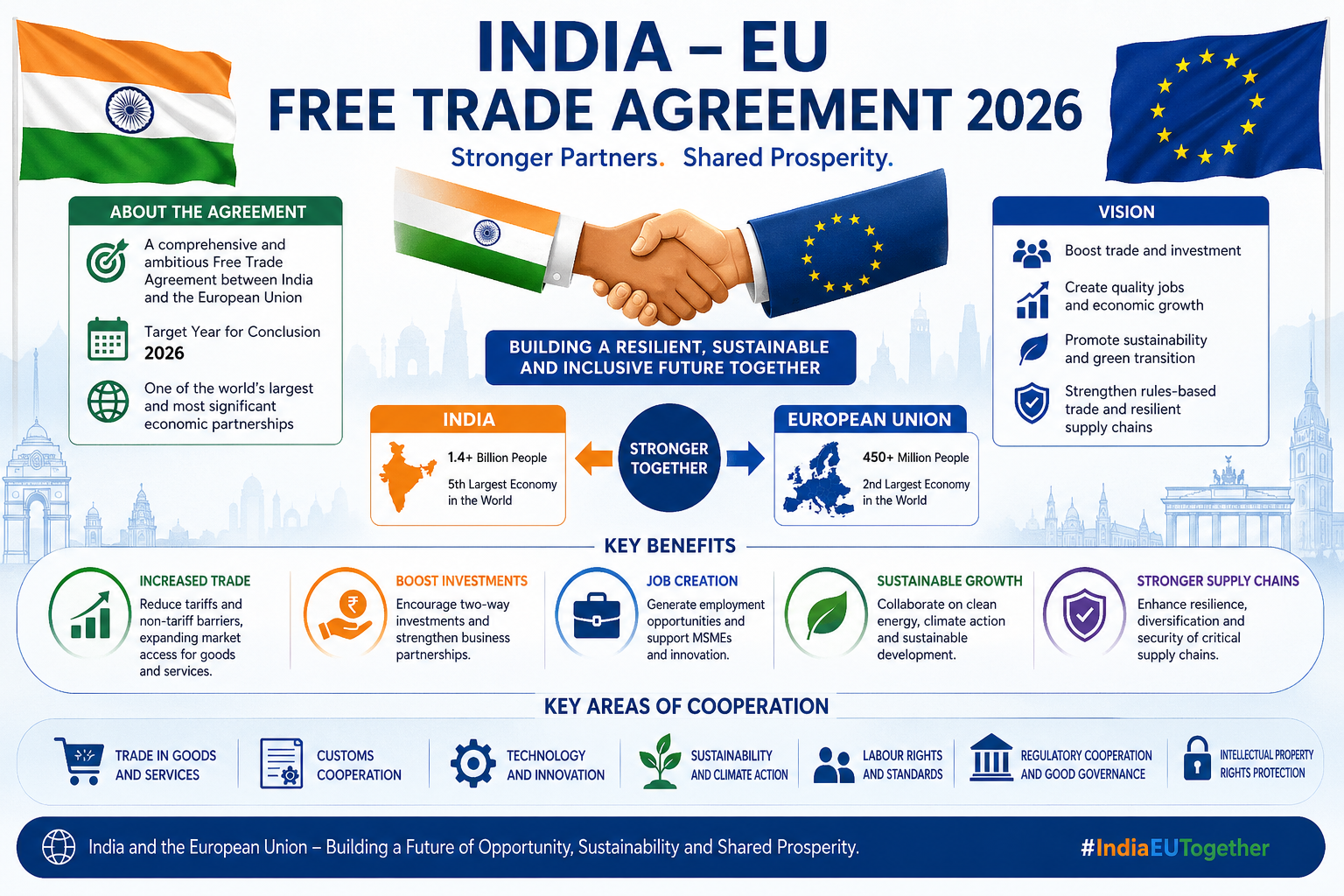
The next morning, the deal was announced at Hyderabad House. Von der Leyen called it “the mother of all deals.” Modi said it would bring “major opportunities for the 1.4 billion people of India and millions of people in Europe.” Hyperbole? Perhaps slightly — but the underlying numbers back up the weight of the moment.
What the Numbers Actually Tell You
Before getting into sector specifics, it is worth grounding this in hard data. India and the EU already trade over €180 billion worth of goods and services annually, supporting close to 800,000 jobs on the European side alone. India is the EU’s ninth-largest trading partner globally, while the EU is India’s single largest trading partner, accounting for over 11.5% of India’s total goods trade in 2024. And yet, Indian exports to Europe have remained constrained because EU tariffs — though lower than India’s — still run between 4% and 26% on key Indian goods.
That changes now. Under the FTA, tariffs on roughly $33 billion worth of Indian exports in labour-intensive sectors drop to zero on the day the agreement enters into force. That covers textiles, apparel, leather, footwear, marine products, gems and jewellery, handicrafts, engineering goods, and more. On the European side, India agreed to phased reduction of its notoriously high tariffs — automobile duties drop from 110% to 10% over time, and tariffs on chemicals, machinery, and pharmaceuticals see meaningful cuts as well.
“Under this agreement, India has created a free trade zone of 2 billion people. Both sides are set to gain economically.” — Ursula von der Leyen, European Commission President
Sector-by-Sector Breakdown: Who Wins and How
Pharmaceuticals and Nutraceuticals
India has long been the pharmacy of the world — accounting for over 20% of global generic medicine exports by volume. But access to the EU market has been complicated by stringent regulatory requirements and tariff barriers that, while lower than other sectors, still added friction and cost. The FTA brings tariff elimination on pharmaceutical exports and creates clearer frameworks for regulatory cooperation and conformity assessment. For companies engaged in pharmaceutical trade and contract manufacturing export, this is a direct competitive advantage. It also opens a structured pathway for nutraceuticals, a segment that has seen explosive demand growth across Germany, the Netherlands, France, and Scandinavia.
Agro-Commodities and Food Products
This is where the deal gets nuanced — and where close reading matters. India gains significantly improved access for marine products, spices, processed foods, and selected agricultural commodities. The EU, on the other hand, maintained protections for its sensitive sectors: beef, chicken, dairy, rice, and sugar see no liberalisation. However, EU exports of olive oil, wines, spirits, and confectionery into India will see duty reductions — which is relevant if you are in the import side of the agro trade.
For Indian agro exporters, the opportunity is real but comes with a compliance caveat. The FTA’s Sanitary and Phytosanitary (SPS) chapter is stringent, with the EU maintaining its world-standard food safety and pesticide testing norms. This means Indian food exporters will need robust quality documentation and certification to benefit. Our team at Soltex’s agro products division has been preparing compliance frameworks precisely for this transition.
Petrochemicals and Industrial Raw Materials
India’s petrochemical industry has been looking for diversified markets, especially as Asian competition intensifies. EU tariff reductions on chemicals and plastics — previously running at up to 22% — open a significant new corridor. The rules of origin provisions in the FTA are aligned with recent EU trade deal templates, ensuring that processed petrochemical products from India qualify for preferential treatment as long as significant transformation occurs within Indian territory. Soltex’s petrochemical supply chain is well-positioned to leverage this opening for both raw material exports and downstream product distribution.
Textiles and Apparel
This may be the single biggest immediate winner of the FTA. Indian textile and apparel exports to the EU currently attract tariffs ranging from 9% to 26%. The FTA drops these to zero. Commerce Minister Piyush Goyal projected this could create six to seven million new jobs in the textile sector alone. Given that the same sector is simultaneously reeling from 50% US tariffs on Indian goods, this EU deal is not just an opportunity — for many manufacturers, it is a lifeline.
Gems, Jewellery, and Leather
Zero duty on entry into force. India’s artisan economy — the skilled craftsmen of Surat, Jaipur, Agra, and Kolkata — has a direct channel to 450 million EU consumers. This sector also intersects strongly with MSME development and women’s employment in manufacturing hubs, which aligns with the FTA’s stated goal of inclusive trade growth.
Comparison: Before and After the India-EU FTA
| Sector / Product | EU Tariff Before FTA | EU Tariff After FTA | Indian Tariff Before FTA | Indian Tariff After FTA |
|---|---|---|---|---|
| Textiles & Apparel | 9% – 26% | 0% (on entry) | 20% – 30% | Phased reduction |
| Pharmaceuticals | 0% – 11% | 0% | 10% – 12% | Reduced, staged |
| Marine Products | 6% – 16% | 0% (on entry) | 30% | Phased reduction |
| Gems & Jewellery | 4% – 10% | 0% (on entry) | 7.5% – 10% | Phased reduction |
| Automobiles (Cars) | 0% (India exports few) | 0% | 110% | Staged to 10% |
| Agro (Wine, Spirits) | N/A (EU exports) | N/A | Up to 150% | Reduced (30% – 50%) |
| Machinery | Varies | Reduced | Up to 44% | Near-eliminated |
| Chemicals & Plastics | Varies | Reduced | Up to 22% | Significantly reduced |
Note: Specific tariff schedules are subject to final legal vetting. Phased timelines vary by product category. Source: European Commission, India Ministry of Commerce.
The Geopolitical Subtext That Changes Everything
Here is what the official press releases will not say plainly: this deal is partly a response to the United States. In 2025, the US imposed sweeping tariffs — including 50% on many Indian goods — leaving Indian exporters scrambling for alternative markets. The EU, simultaneously dealing with strained trans-Atlantic relations under the Trump administration’s pressure over Greenland and NATO commitments, also needed to demonstrate that its rules-based trade architecture still delivers results.
India and the EU found common ground not just in economics but in shared political messaging. The FTA explicitly references democratic values, rules-based trade, and the Paris Climate Agreement. This is trade policy as geopolitical alignment — and it makes the deal more durable than a purely transactional arrangement would be. Both sides have skin in making it work.
From a practical standpoint, what this means for Indian exporters is strategic: the EU market is now more accessible at the same moment that US market access is more uncertain. Companies that diversify their export mix toward Europe in 2026 will be better positioned than those that wait.
Services, Mobility, and Digital Trade: The Often-Missed Provisions
Most commentary focuses on goods. But the FTA’s services chapters deserve serious attention.
India secured a framework to engage on Social Security Agreements over a five-year horizon — which matters enormously for Indian IT and services professionals posted to Europe. There are provisions supporting student mobility and post-study work pathways for Indian graduates in EU member states. India also secured access for practitioners of Indian traditional medicine to work in EU countries where such practices are unregulated — a quiet but significant win for Ayurveda and Siddha practitioners eyeing the European wellness market.
The Digital Trade chapter, one of the last to close during the July 2025 negotiating round, creates rules on cross-border data flows, electronic authentication, and digital signatures that align India more closely with EU regulatory norms. For fintech and digital services exporters, this reduces friction and legal uncertainty considerably.
What Indian Exporters Should Do in the Next Six Months
The agreement requires approval by the EU Council and Parliament, as well as India’s Union Cabinet, before entering into force. Commerce Minister Piyush Goyal projected entry into force by late 2026. That gives companies a preparation window — but preparation cannot wait until the last mile.
Here is a practical checklist:
- Review your HS codes and tariff classification — Identify which of your product lines fall under zero-duty categories at entry into force versus phased schedules.
- Audit your rules of origin compliance — The FTA’s origin rules are strict and aligned with recent EU templates. If you source inputs internationally, assess whether your Indian value addition qualifies.
- Get EU market certifications in order — CE marking for machinery, GMP certification for pharma, EU organic certification for agro products. These have lead times. Start now.
- Identify your EU market entry points — Germany, the Netherlands (Rotterdam as a logistics hub), Belgium, France, and the Nordic countries each have different demand profiles. Segment, don’t scatter.
- Partner with experienced trade intermediaries — The compliance, documentation, and logistics complexity of EU trade is real. Working with experienced global trade partners can dramatically reduce the learning curve.
At Soltex Trade India, we have been facilitating exports to European markets for years — and we are already mapping FTA-specific opportunities for our product categories. If you want to move before the crowd, this is the time to have that conversation.
A Note on What the FTA Does Not Do
No analysis is complete without acknowledging limitations. The FTA does not eliminate non-tariff barriers overnight. EU regulatory standards for food safety, environmental norms, and product conformity remain unchanged — and for many Indian exporters, those are the harder wall to climb. The deal also does not cover the EU’s Carbon Border Adjustment Mechanism (CBAM), which will impose a carbon price on cement, steel, aluminium, fertilisers, and electricity from 2026 onwards. Indian exporters in those sectors need to assess their carbon footprint and supply chain independently.
Additionally, while the deal reduces Indian tariffs on European automobiles gradually — from 110% to 10% over several years — Indian automobile manufacturers will face increased competition in the premium segment. That is a domestic industry adjustment India will need to manage carefully.
The FTA is a framework, not a guarantee. The firms that benefit will be those that actively work the new access, not those that passively wait for business to arrive.
Frequently Asked Questions
Ready to Export to Europe Under the New FTA?
Whether you are in pharmaceuticals, agro commodities, petrochemicals, or textiles — Soltex Trade India has the expertise, certifications, and market relationships to help you navigate the new India-EU trade landscape. Let us help you turn tariff reductions into revenue.